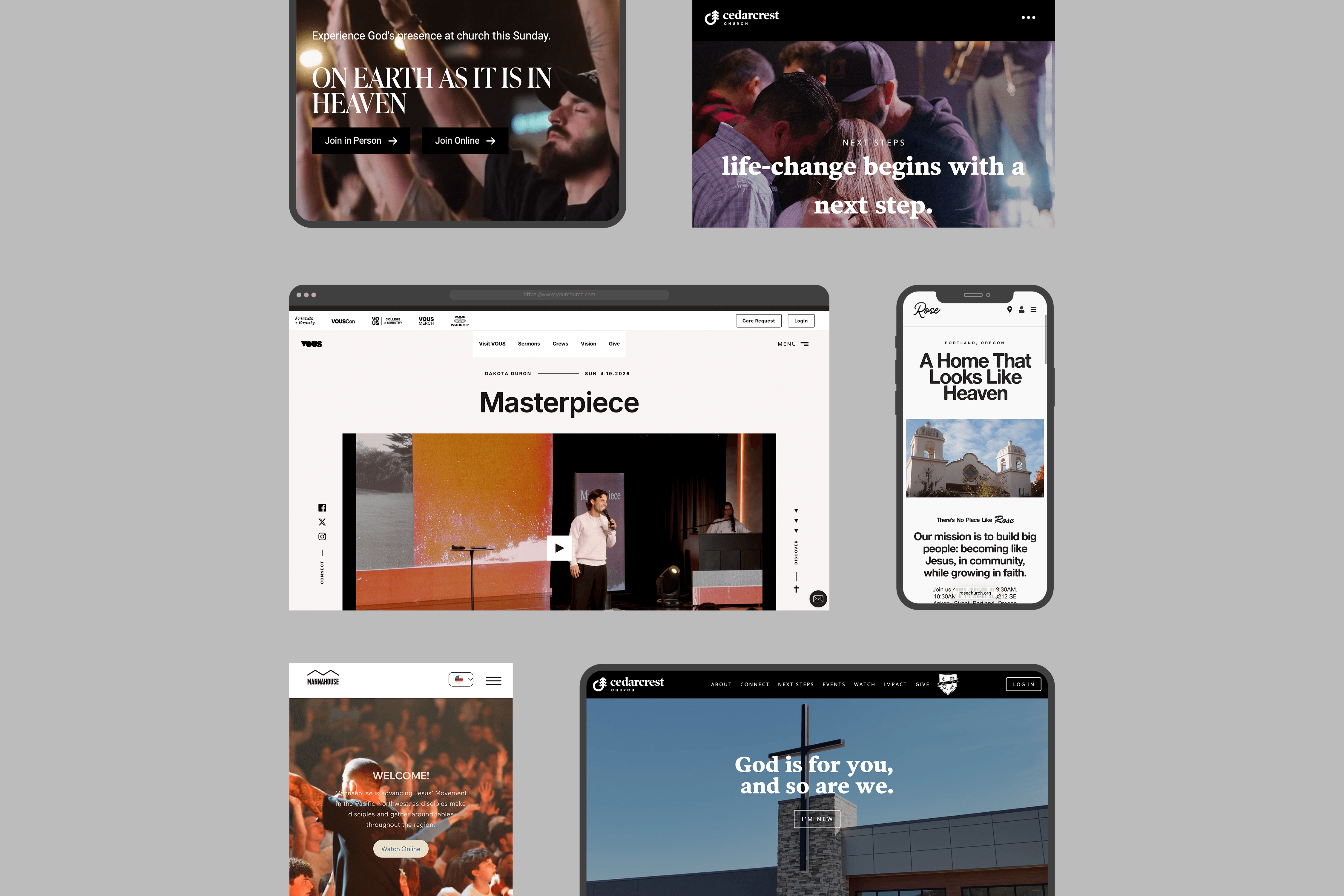

A website that "works" isn't just one that loads and has your address on it. It's one that serves your mission: welcoming first-time visitors, helping current members stay connected, and making next steps — attending, giving, volunteering, reaching out — feel clear and simple.
Your church or nonprofit has a website. Most do. The question isn't whether you have one — it's whether it's working.
For most faith-based organizations and nonprofits, the website is one of the first places potential attendees, donors, or partners will visit. What they find there will shape whether they take the next step or quietly move on.
What Most Church and Nonprofit Websites Get Wrong
They're written for insiders
The most common problem with church and nonprofit websites isn't design. It's language. The site is written for people who already know the organization — people who understand the insider terms, the ministry names, the event structures, and the culture.
A first-time visitor lands on a church website and sees: "Join us for Connect Groups, “Church name” Kids, or a SERVE Weekend." These terms won’t mean anything to someone who has never attended. The site has failed its most important visitor.
Every page, every piece of copy, should be written with the first-time visitor in mind. What do they need to know? What are they afraid of? What questions are they asking before deciding to show up?
The call to action is unclear
Many nonprofit and church websites feature beautiful imagery and compelling mission statements, but they leave the visitor with no clear next step. "Learn more" is not a call to action. "Get involved" isn’t either. These are too vague.
A real call to action names one action and makes it easy to take. For a church, that might be "Plan your first visit." For a nonprofit, it could be "Start a monthly gift" or "Volunteer this month." There should be a clear answer on every major page to this question: What should I do right now?
Mobile is an afterthought
More than half of web traffic — and often significantly more for community-oriented organizations — comes from mobile devices. A website that works well on a desktop but breaks, loads slowly, or requires pinching and zooming on a phone is turning away the majority of its visitors.
Mobile-first design is not a trend. It is the baseline. This means your most important information should be effortless to find with one thumb: service times, location, what to expect, contact, and giving or volunteering. Buttons should be large enough to tap, pages should load quickly on cellular data, and forms should be short and frustration-free.
If mobile visitors have to hunt, pinch, or guess, they won’t push through — they’ll move on.
The site hasn't been updated since it was launched
A website that shows a 2021 sermon series on the Homepage, lists a staff member who left two years ago, or hasn't published a blog post since COVID is communicating something: that no one is paying attention. That erodes trust, even if the organization itself is vibrant and active.
Content currency is a credibility signal. Regular updates — even small ones — tell visitors that the organization is alive and well. The goal isn’t constant content — it’s visible care. Keep the Homepage current, remove outdated events, and make sure the basics are accurate: service times, staff, location, and contact info. Even a simple rhythm helps: one weekly Homepage check-in and one monthly “website cleanup” to archive old pages and refresh key information.
When the site is maintained, visitors feel the difference — and they trust what you say elsewhere, too.
What a High-Functioning Website Actually Does
Answers the visitor's first question in seconds
For a church: What is this place, and would I fit in?
For a nonprofit: What do you do, and does it match what I care about?
For a faith-based business: Can I trust these people to do good work for me?
The answer to this question should be immediately apparent from the Homepage — not hidden in an About page, and not buried halfway down the screen.
Builds trust before asking for commitment
First-time visitors aren't ready to give, serve, or sign up for anything. They're evaluating. They want to see real people, real stories, real evidence that this organization is what it says it is.
This is where photography, case studies, testimonials, and authentic storytelling earn their value. Every element on your site is either building or eroding the trust that precedes a decision.
Makes the next step obvious
Every page on your site should have one primary thing it's asking the visitor to do. The Homepage asks them to learn more or plan a visit. The About page asks them to see your work or meet the team. The Blog asks them to read another post or book a call.
A clear hierarchy of calls to action — designed into the site, not bolted on afterward — is what turns visitors into connections.
Works for search engines and AI discovery
A website that works for your visitors also needs to be findable by people who don't know you yet. This means thoughtful structure, clear page titles, quality content that answers specific questions, and attention to local SEO for geographically-relevant organizations.
For churches and nonprofits especially, showing up in searches for "[type of org] in [city]" or "[specific topic] for [specific audience]" can be a meaningful source of new connections.
The Investment Question
Many faith-based organizations treat the website as a line item to minimize rather than an asset to invest in. This is understandable — budgets are real, and the website can feel abstract compared to direct ministry expenditures.
But consider: your website is the first impression for every person who discovers your organization online. It works 24 hours a day, seven days a week, reaching people your staff never could. It is the infrastructure on which your digital presence, giving campaigns, and event communications all depend.
For organizations whose work is meaningful and whose funding depends on trust, a website that fails to communicate that meaning and build that trust is a cost, not a saving.
A well-designed, well-maintained website is an act of stewardship — of your mission, your message, and the people you're trying to reach.
What to Prioritize First
If you're starting from scratch or rebuilding, here's a simple priority order:
Clear positioning — What you are, who you serve, and why it matters. This should be visible immediately on the Homepage without scrolling.
A primary call to action — One thing the visitor should do next. Make it obvious.
Mobile-first design — Build for the phone first. Desktop is a bonus.
Real photography — Real people, real spaces, real moments. Stock photos are placeholders, not brand assets.
A content plan — At minimum, a Blog or News section that can be kept current. Fresh content serves both visitors and search engines.
From this foundation, everything else — event pages, donation forms, resource libraries, sermon archives — can be built with purpose.
Horsfall Design Co. builds websites for churches, nonprofits, and faith-based organizations that are designed to work — for visitors, for search, and for the mission. Book a fit-check call to talk about what your organization needs.
Check out our FAQ for some answers to common questions or ask us directly via our contact page!
Let’s keep in touch.
Discover more about high-performance web design. Follow us on Twitter and Instagram.